Marbella monthly costs in 2026: rent, utilities, groceries, healthcare, and transport — exact numbers, not the brochure version. Updated July 2026.
🏠 The Monthly Bill: What One Couple Actually Pays
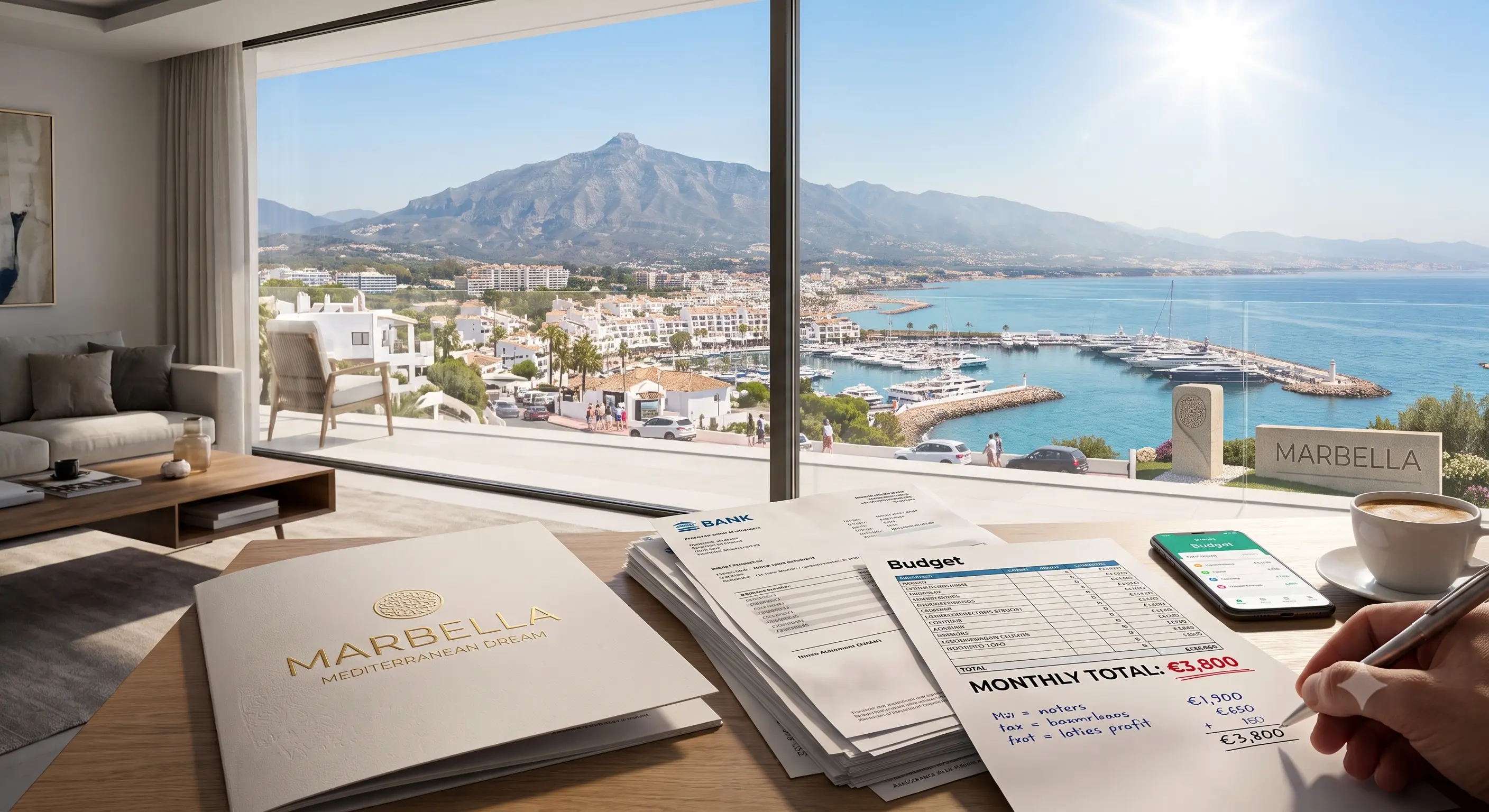
Forget averages pulled from tourism boards. A realistic 2026 budget for a couple living in central Marbella — renting a two-bedroom apartment, eating mostly at home, one car, private health cover, no children — runs between €3,400 and €4,200 per month before discretionary spend. Add a child in international school and the line jumps by €1,000 to €1,400. Add fine dining twice a week and golf membership and you are looking at €6,500+ without breaking a sweat.
These numbers are not aspirational. They are what residents report in 2026 across Nueva Andalucía, the Marbella centre, and the San Pedro side. The variance comes down to housing choice and lifestyle habits — not the country.
📊 Housing: Rent vs Buy — The Real Numbers
Rental prices in Marbella held firm through 2025 and ticked up roughly 6% into 2026 on sustained demand from northern European buyers testing the waters before committing to purchase. Buy-side inventory remains tight in the €400,000–€700,000 bracket — the segment where most relocating couples actually shop.
⚡ Utilities: Electricity, Water, Internet, Gas
The 2022 energy spike taught every Costa del Sol resident what brokers still fail to disclose: cooling bills in July and August can hit €250–€350 for a two-bedroom apartment with air conditioning running twelve hours a day. Winter reverses — gas heating or electric radiators run €60–€120 monthly from December to February.
Water in Marbella is supplied by Hidralia and runs €25–€60 monthly for a couple without a pool. Add a private pool and expect €120–€220 in summer — pool pumps, water top-ups, and chemical treatment add up fast. Fibre internet from operators like Movistar, Vodafone, or Avatel is €40–€70 per month for 600 Mbps to 1 Gbps lines.
🛒 Groceries and Dining Out
Spain's food costs remain reasonable compared to London, Geneva, or Scandinavia — but Marbella sits 12–18% above the Spanish national average because of tourist-area pricing and the imported-goods premium in upscale supermarkets. A couple shopping at Mercadona, Lidl, and the local market can eat well at home for €450–€650 per month. The same basket at El Corte Inglés or an organic specialist runs €700–€950.
Dining out is where Marbella punishes careless budgets. Tapas and a glass of wine at a traditional bar: €12–€18 per person. Mid-range restaurant dinner for two with wine: €55–€80. Fine dining on the Golden Mile or in Puerto Banús: €120–€220 per head before wine. A couple dining out twice a week at mid-range spends €500–€700 monthly. Three times a week at fine-dining venues: €1,800+.
🏥 Healthcare: Public, Private, and the Realistic Setup
Spain's public healthcare system is excellent — once you are paying into social security as a resident. Until that point, you need private cover or you pay out of pocket. Most non-resident expats and recent arrivals take private insurance from providers like Sanitas, Adeslas, DKV, or ASISA. Premiums run €80–€160 per month per adult for solid coverage with no copay, €200–€280 for premium plans with dental and global cover.
Once you secure residency and start paying into the Seguridad Social system, public cover becomes available. Most expats keep a basic private policy on top — €60–€90 per month — because public hospital queues for non-urgent specialists can stretch four to eight weeks in the Málaga region.
🚗 Transport: Why You Need a Car
Marbella has no metro, no tram, and a public bus network that runs on a schedule designed for residents who retired here twenty years ago. You need a car. Most expats lease rather than buy — a three-year lease on a mid-size SUV (Hyundai Tucson, Peugeot 3008, Volvo XC40) runs €450–€650 per month including maintenance. Buy used and you cut that to €250–€400 in depreciation, insurance, and fuel.
Fuel in Spain sits at €1.62–€1.72 per litre for diesel and €1.68–€1.78 for petrol in July 2026. Highway tolls are minimal on the Costa del Sol — the AP-7 is free since 2020 — but parking in central Marbella and Puerto Banús during summer adds €15–€25 per day for monitored lots.
🏫 Schools: The Line Item That Changes Everything
Public schools in Spain are free and the teaching is solid — but instruction is in Spanish. If your children do not speak Spanish on arrival, you have three real options: a Spanish public school with a transition year, a concertado (semi-private) school with bilingual track, or a fully private international school.
For families with two children at international school, education alone adds €20,000–€35,000 to the annual budget. This is the single largest cost variable in any Marbella relocation plan.
💵 Annual Taxes Non-Residents Actually Pay
Owning property in Spain as a non-resident triggers three annual obligations most buyers discover only after the notary has left. IBI is the local property tax, charged at 0.4%–1.1% of the cadastral value depending on the municipality. On a €600,000 villa in Marbella, expect €1,800–€3,500 per year. Basura (waste collection) adds €150–€300. Comunidad de Propietarios (community of owners fees) for a villa in a gated urbanisation runs €100–€400 per month and covers gardens, pools, security, and common-area maintenance.
If you rent out the property, declare the rental income in Spain even if you are a non-resident — flat 24% withholding on EU/EEA residents, 19% on EU residents under certain treaties since 2023, with deductions available for property costs, IBI, community fees, and depreciation. File Modelo 210 quarterly. Skip this and the Agencia Tributaria will eventually find you — they are unforgiving on rental income from foreign owners.
- Set the housing budget first — it sets the floor for everything else. €1,800–€2,400 monthly rent is the realistic 2-bed bracket in central areas.
- Reserve €400 monthly for utilities in summer months, €200 in winter. Plan for the August spike, not the average.
- Open a Spanish bank account before arrival. Bankinter, CaixaBank, and Sabadell all offer non-resident accounts. Avoid fees by keeping €5,000+ minimum balance.
- Apply for NIE on arrival — required for everything from the bank account to the car purchase to the healthcare application. Expect 4–8 weeks through the Málaga consulate or foreigner's office.
- Decide on private health cover within the first month. Pre-existing condition clauses bite after the cooling-off period.
- Budget €500–€800 monthly for groceries and €400–€700 for discretionary dining. This is the line most expats underestimate.
- If you have children, lock down school placement six months before relocation. The international schools fill up by February for September intake.
- Register cars and driving licences within six months of becoming resident — Spanish residency law requires it, and fines for driving on a non-resident licence after that are €200+.
- Hire a gestor for the Modelo 210 filings and annual tax declarations. Budget €400–€800 per year for a competent one in Marbella.
📋 What Marbella Costs Compared to Alternatives
The pitch from relocation advisors is that Marbella delivers Mediterranean lifestyle at half the cost of London or Geneva. That was true in 2015. In 2026 the gap is narrower — but Marbella still wins on climate, healthcare access, and the absence of capital gains tax on primary residence sales for non-residents (only the savings-and-rental portion gets taxed).
The catch is that Marbella's premium is no longer a coastal-tax for sun and beaches. It is a premium for the international school network, the existing expat community infrastructure, and the proximity to Málaga airport. If those matter to you, the premium is justified. If you do not need them, Alicante delivers 80% of the lifestyle at 60% of the cost.
🔍 The Bottom Line for 2026
Marbella remains one of the better-run Mediterranean destinations for international relocators — not the cheapest, but the one with the most complete infrastructure for non-Spanish-speaking families. The numbers above assume a couple with average consumption habits, one car, no holiday-home mortgage, and no private school. Adjust upward for the variables that matter to your situation.
Anyone quoting you a flat "Marbella costs €X per month" without specifying housing choice, family size, school decisions, and dining habits is selling you a brochure. The real cost is what you choose to do once you live here.
📞 +34 624 770 233 · WhatsApp · 📧 info@cerealestates.com
🌐 Request a Relocation Cost Consultation
Ready for the lifestyle?
Download our exclusive free guides to learn everything about living and investing in Spain.
Explore Expert Guides