
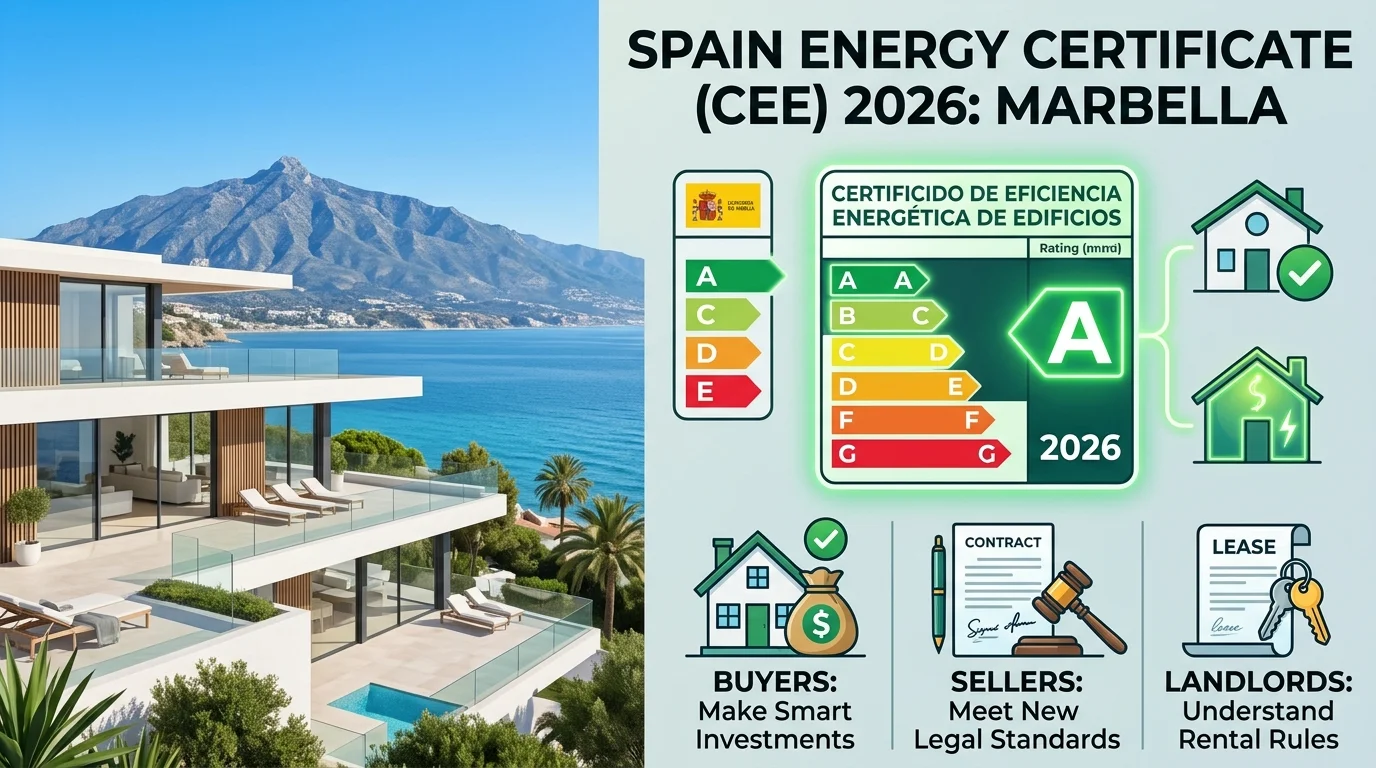
Spain requires a CEE for every sale or rental. Costs €150-300, 10-year validity. From 2030, F/G-rated homes cannot rent in the EU under EPBD 2024/1275.
⚖️ Why the CEE Now Decides Whether Your Property Can Rent in 2030
Spain's Certificado de Eficiencia Energética (CEE) is not a marketing label. It is the document the notary requires on every escritura de compraventa, the document the tenant must see before signing any lease longer than four months, and the document the regional energy authority inspects during a rental compliance audit. Spain adopted the original framework under Royal Decree 47/2007, recodified it as Royal Decree 390/2021, and operates within the EU Energy Performance of Buildings Directive. The 2024 recast of that directive (EU 2024/1275, in force since 28 May 2024, transposition deadline 29 May 2026) tightens the rules for low-rated homes across the entire Union.
The Marbella impact is concrete. The 2030 cliff applies to every residential property with an F or G rating — the two worst grades on Spain's seven-step A-G scale. As of October 2025, an estimated 35-40% of Costa del Sol's older villa stock sits at E, F, or G. That is roughly 18,000-22,000 homes in the municipalities of Marbella, Estepona, and Mijas combined. Owners who do not raise the rating before 2030 will be unable to sign new leases, and renewals of existing leases become progressively restricted through 2030-2033.
📊 The A-to-G Rating Scale: What Each Letter Means in kWh and in Bills
Spain's CEE scale runs A through G, with two open-ended brackets: A (the most efficient, with CO2 emissions under 8.2 kg CO2/m²·year) and a separate A with an additional letter or "A 0 emisiones" label for properties that produce as much energy as they consume over a year. The two worst ratings — F (≥ 64.6 kg CO2/m²·year) and G (≥ 88.7 kg CO2/m²·year) — are the regulatory cliffs that matter in 2026-2033. A 1980s Marbella villa with single glazing, no cavity insulation, and an electric-resistance water heater will almost always land at E, F, or G. A 2020 new-build in Cancelada with aerothermal HVAC and 6 kWp solar panels will register A or B.
The label shows the consumption in two units: primary non-renewable energy (kWh/m²·year) and CO2 emissions (kg CO2/m²·year). Both are calculated under standard use assumptions, not measured from actual bills. A villa rated B may still post a high summer bill if the owners run air-conditioning 18 hours a day; a villa rated D may be cheap to run if the owners live elsewhere 11 months a year.
💶 CEE Costs by Property Type: What the Inspection and the Label Actually Cost in 2026
The inspection fee is unregulated. There is no fixed price for a CEE in Spain; each autonomous community registers qualified technicians, and the market sets the rate. Andalucía alone lists more than 4,500 active certificadores at the Junta de Andalucía register. Fees in Málaga province in 2026 cluster around €180-€280 for a standard apartment and €300-€500 for a detached villa, depending on size, accessibility, and whether the technician needs to return for missing documents. A few high-end specialists in Marbella charge €600-€800 for premium villa inspections that include a written recommendations report.
📋 When You Need a New Certificate: Sale, Rental, Renovation, New Build
Spain requires a valid CEE on four trigger events: sale, lease longer than four months, major renovation, and first occupation of a new build. The certificate is valid for 10 years from the issue date — but the moment any of those events occurs, the existing label must be re-registered, and the seller or landlord is liable for showing the updated label to the buyer or tenant. There is no automatic reissue; the inspection is on the owner's dime every time.
🔧 The Inspection Process: What the Technician Actually Checks
The CEE technician is not the same as a building surveyor. They do not assess structural soundness, damp, or roof integrity. They assess energy performance: the building envelope, the HVAC system, the water heating, the lighting, and the ventilation. The on-site visit covers five categories of data collection, all of which feed into the CE3X or CE3X2 software the Junta de Andalucía approves for residential properties.
The technician measures or records: (1) the wall, roof, and floor U-values (heat-loss coefficients), with defaults applied if no insulation documentation exists; (2) the type and age of the window frames and glazing; (3) the HVAC system — whether it is a single split, multi-split, ducted air-air, air-water heat pump, gas boiler, or electric resistance; (4) the domestic hot water system — boiler type, age, and whether solar thermal panels exist; (5) the ventilation strategy — natural through grilles, mechanical extraction, or heat recovery. Photovoltaic panels and battery storage are noted but treated as on-site generation that reduces net consumption. The technician also pulls the cadastral reference, the property registry inscription, and the previous CEE if one exists.
The output is a four-page PDF: an energy label with the A-G rating and kWh/m²·year figure, a list of recommended upgrades ranked by cost-effectiveness, an emissions breakdown, and a unique CEE registration code that the technician uploads to the regional authority. The label is valid for 10 years unless a major renovation changes the underlying data.
- Property: 110 m² two-bed apartment in Marbella centre, built 1998, single-pane aluminium windows, two split A/C units, electric water heater, no solar. Existing CEE from 2018 = E (47.2 kg CO2/m²·year). Validity expired in 2028.
- Seller commissions a new CEE from a Málaga-registered technician. On-site inspection on Tuesday morning, report issued Friday. Cost: €240.
- New rating: D (35.1 kg CO2/m²·year, 92 kWh/m²·year primary energy). Drop from E to D came from inverter A/C retrofitted in 2022 and a 2023 condenser boiler upgrade — both captured in the inspection.
- Seller inserts the new CEE in the reservation contract. Buyer sees a D label — borderline E, not F or G. Sale proceeds at asking €600K.
- If the rating had come back at F: the seller faces three choices — sell at a €30K-€50K discount to absorb the buyer's expected renovation cost, complete a €25K-€40K upgrade (double glazing, inverter A/C, aerothermal water heater) to lift the rating to D or C, or withdraw from the market.
- Buyer's loan application: the bank's tasadora requires the CEE as part of the appraisal file. A D rating is acceptable to all major Spanish lenders. An F or G rating often triggers a 10-15% LTV haircut or a refusal — the bank cannot easily resell the asset if the borrower defaults.
🚨 Penalties for Missing or Inaccurate CEE in 2026
Spain's penalty regime sits at the autonomous community level, with Andalucía operating the most aggressive enforcement in 2024-2026. The Junta de Andalucía's energy authority (Agencia Andaluza de la Energía) runs random CEE audits on advertised rental properties and on notarial sale records. The base penalty for missing or outdated CEE on a sale is €600-€1,500 for a infracción leve (minor) and €1,500-€6,000 for infracción grave (serious), under the Decreto Legislativo 6/2015 framework that Andalucía applies. For holiday rentals under Decreto 31/2024, missing or invalid CEE triggers an additional €2,000-€60,000 fine on top of the energy fine, because the property may be operating without the required tourist classification.
The notary risk is more immediate than the administrative fine. A notary who signs a escritura de compraventa without a valid CEE registered to the property risks disciplinary proceedings and personal liability. In practice, every Spanish notary refuses to sign a sale without the seller's CEE uploaded to the regional register. The deed itself is not invalidated, but the registration at the Registro de la Propiedad is delayed until the CEE is filed, which freezes the buyer's title and any subsequent sale. That is more expensive than the fine.
✅ What Buyers, Sellers, and Landlords Should Do in 2026
Buyers should add the CEE to their due-diligence checklist alongside the nota simple, the IBI receipt, and the community-of-owners certificate. Three actions make a difference: (1) demand the existing CEE before signing the reservation contract — refuse to proceed without it; (2) if the rating is F or G, commission your own independent CEE (€180-€300) before the reservation deposit hardens, because the seller's certificate may be optimistic; (3) factor the rating into the price negotiation — an F rating on a €500K property is realistically a €20K-€40K discount against the cost of upgrading to C or D.
Sellers should commission a new CEE the moment a sale is contemplated, not the week before the notary signing. The technician's appointment book fills 2-3 weeks ahead in Marbella from March to October. A 2026 CEE also gives a defensible 10-year runway if the buyer wants to refinance within the decade. If the rating comes back at F or G, decide before listing whether to upgrade first or discount the price. Upgrading is usually cheaper than the discount, because a C or D rating pulls in 8-15% more buyer pool than an E or F.
Landlords should treat the CEE as an annual compliance check, not a one-off. The 2026-2033 horizon narrows every quarter. For any F or G-rated property held today, the renovation plan should be on a contractor's quote sheet by Q4 2026 and the works scheduled for 2027-2028 — well before the 2030 rental ban and ahead of the 2030-2033 construction cost inflation that will hit when every F and G owner in Andalucía tries to upgrade at once.
- Locate the current CEE — ask the seller's agent, the community president, or your property manager. If none exists, commission one now.
- Check the validity expiry date. Anything issued before 2016 is lapsed and useless for the next sale or rental.
- Match the rating to your use case — F or G owners who plan to rent must budget for renovation by 2027.
- File the CEE at the regional authority (Junta de Andalucía) if the original technician didn't — the registration is searchable by the notary and the next buyer.
- Re-commission the CEE after any major works (>25% envelope value) — the rating changes with new insulation, glazing, or HVAC.
The CEE is the cheapest document in the Spanish property process. It is also the one with the longest regulatory tail. Treat it as a five-year asset signal, not a notary formality.
📞 +34 624 770 233 · WhatsApp · 📧 info@cerealestates.com
🌐 Request an Energy Performance Consultation
Ready for the lifestyle?
Download our exclusive free guides to learn everything about living and investing in Spain.
Explore Expert Guides

